patents.foundation — Original First-Print Patent Specifications

A private foundation

The first printed record of the modern world.

Original first-print patent specifications — the earliest published state of the documents in which the modern age was set down.

Exhibitions & fairs

On view

The collection is not permanently on display. Selected documents travel to a small number of international fairs each year, where they can be examined in person and discussed with the curator.

18–20 September
2026

Berlin

{{ berlinImageAlt }}

Rare Books Berlin

Kronprinzenpalais · Unter den Linden 3 · Berlin

The inaugural edition of Rare Books Berlin, the closing event of Berlin Rare Book Week (14–20 September 2026), hosted by the Verband Deutscher Antiquare and ILAB. On show: nineteen first-print German imperial patent specifications, 1877–1898 — among them the document recognised by UNESCO as the birth certificate of the automobile, shown in the city where it was filed.

{{ berlinStatus }}
November
2026

Vienna

{{ wienImageAlt }}

Buch Wien

Messe Wien, Halle D · Trabrennstraße 7 · Vienna

Austria's principal book fair, and the collection's appearance in the city where it is kept. A small selection is shown alongside the antiquarian trade, with the curator present for conversations on the documents and the method behind their attribution.

Dates to be confirmed

15–18 April
2027

New York

{{ newYorkImageAlt }}

New York International Antiquarian Book Fair

Park Avenue Armory · 643 Park Avenue · New York

The collection's next appearance in the United States. The selection and the accompanying catalogue will be announced here in advance of the fair.

Details to be announced

Further international appearances are announced on this page. For a private viewing outside these dates, please write to us.

A first glimpse

What a patent specification is

Long before an invention becomes a product, it becomes a document. The patent specification is the moment an idea is first written down, drawn, dated and made public — the earliest surviving record of a thought that went on to change the world.

01

The moment of invention

A specification is filed before the invention exists in the world. It captures the idea at its earliest provable state: the claim, the drawings, the date, the office stamp. Nothing that comes later is closer to the origin.

02

Why the first print matters

Patents can be reproduced endlessly — later editions, library sets, photocopies. Only the first print is the state in which the document left the patent office at the moment of grant. It is distinguishable, and every item here has been checked.

03

Single documents and themes

Alongside significant individual patents, it is above all the thematic groups that attract international interest. Each is offered as a coherent whole, researched and attributed item by item.

1802–1975

Span of filing years

From the collection

Three documents

A collection of this kind is best understood through single objects.

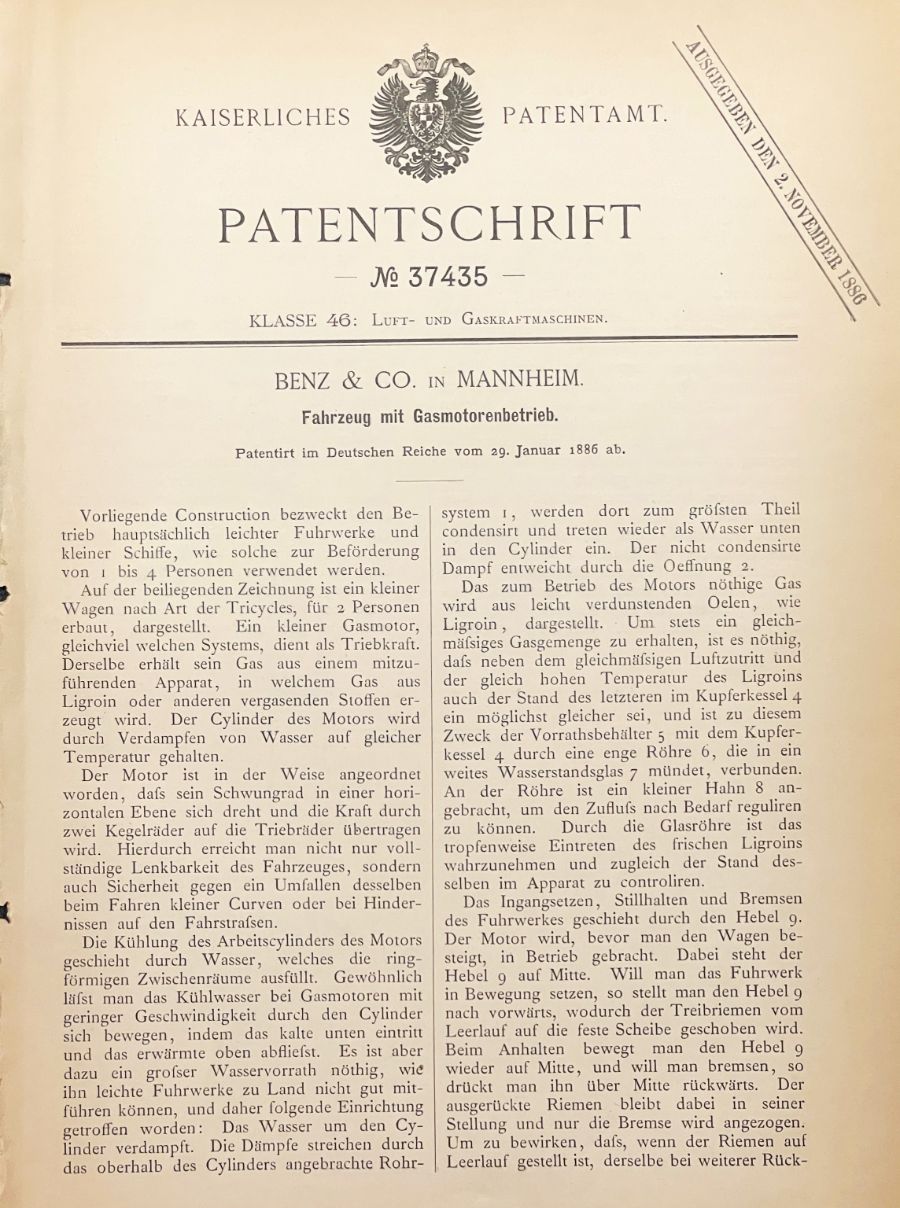
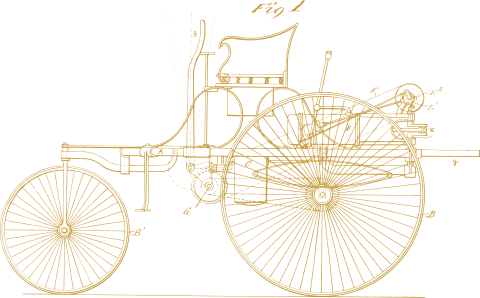
Patent specification DE 37,435, title page — Kaiserliches Patentamt, Benz & Co. in Mannheim, “Fahrzeug mit Gasmotorenbetrieb”, patented in the German Reich from 29 January 1886

DE 37,435 · 1886

The birth certificate of the automobile

Filed on 29 January 1886 at the Imperial Patent Office in Berlin under the unremarkable title “Vehicle powered by a gas engine.” Inscribed in the UNESCO Memory of the World Register in 2011.

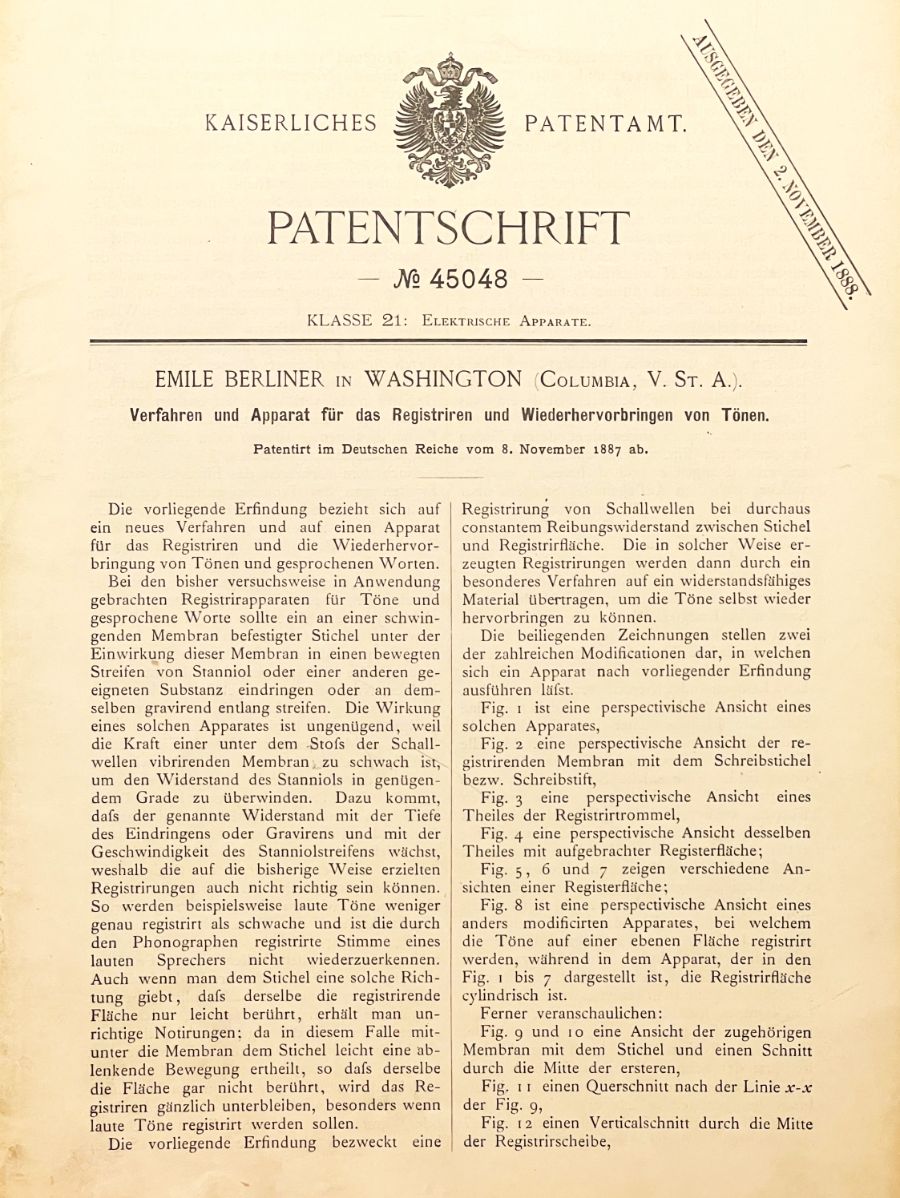
Patent specification DE 45,048, title page — Kaiserliches Patentamt, Emile Berliner in Washington, “Verfahren und Apparat für das Registriren und Wiederhervorbringen von Tönen”, patented in the German Reich from 8 November 1887

DE 45,048 · 1887

The birth certificate of the record

Emil Berliner's method of “registering and reproducing sound” replaced the cylinder with the disc — and made recorded music reproducible. Filed in Berlin by a Berliner.

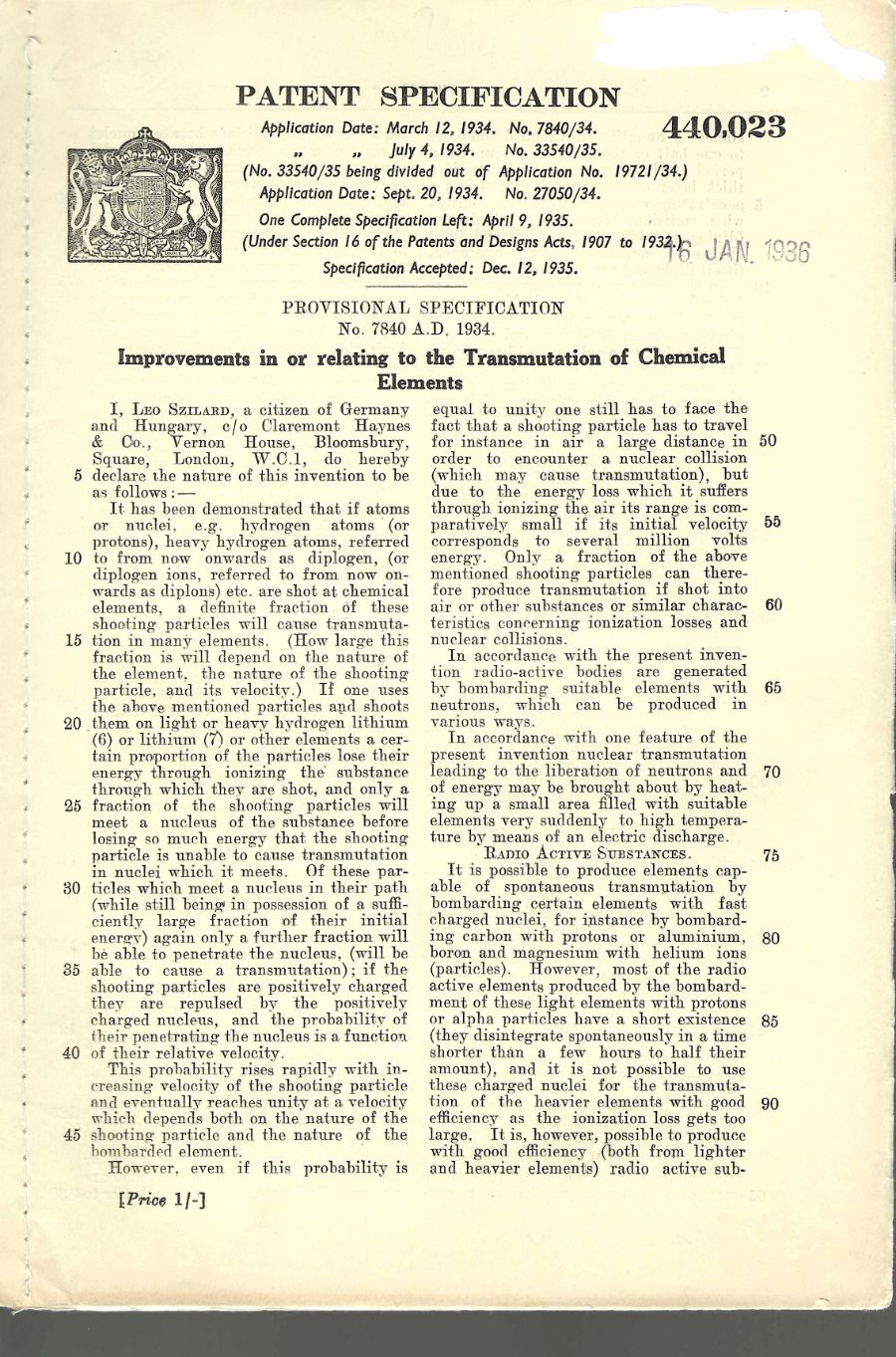
British patent specification No. 440,023, title page — Leo Szilard, “Improvements in or relating to the Transmutation of Chemical Elements”, application dated 12 March 1934, accepted 12 December 1935

GB 440,023 · 1934

The conceptual birth of the atomic age

Leo Szilard's specification on the transmutation of chemical elements, filed four years before nuclear fission was understood. The atomic age begins in the mind of a single émigré physicist.

More documents are presented in the catalogues →

Publications

Catalogues

Each appearance is accompanied by its own catalogue — a curated selection, researched and documented item by item, with printer, collation and provenance recorded for every document.

Catalogues are published as digital editions and read in the browser. Printed copies are available at the fair.

Stewardship

The curator

The collection is curated by an Austrian antiquarian, an internationally recognised specialist in the printed heritage of science. He spent much of his career in the art trade before turning to historical patent specifications, a field in which he is among the very few authorities worldwide — consulted by collectors and institutions on attribution and provenance, and the author of the published method used to distinguish a first print from a later reprint.

That method is applied, item by item, to every document held here. He selects what travels to each fair, writes the catalogues, and answers enquiries personally.

“Every great invention has its origin in the mind and is published first and foremost as a patent.”

The curator

Origin

One collection. Documented provenance.

The strength of a collection is not only what it contains, but knowing exactly where it came from. 

What the market almost never offers is a body of patents covering the same subjects across the patent systems of several different countries. 

The collection is held by a private foundation, which preserves it, makes it accessible through exhibitions and publications.

Full provenance documentation is available to serious enquirers under confidentiality.

Contact

Enquiries

Enquiries are answered personally and treated confidentially — whether you are considering an acquisition, planning an exhibition, or researching a specific document.

office@patents.foundation

Please include the document or theme you are interested in.
Requests for private viewings outside fair dates are welcome.